

November 2025
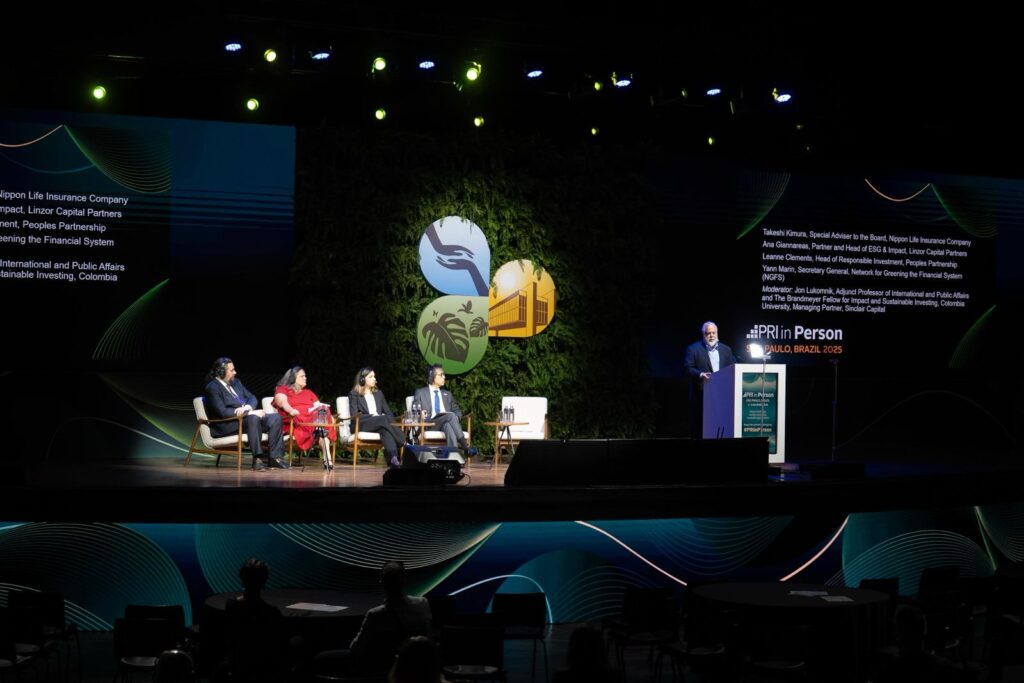
The PRI in Person conference convened in São Paulo this year — the first time in over a decade that this flagship event by the Principles for Responsible Investment (PRI) has been held in Latin America. The three-day gathering brought together nearly 1,300 leading investment professionals from across the world to discuss sustainable finance, environmental and social integration, and the role of private capital in driving real impact.
As one of the leading Latin American private equity firms, Linzor was proud to participate — represented on stage by our own partner, Ana Giannareas — and take part in conversations about how investors can align purpose and performance to generate system-level impact across the region.
Why private markets matter more than ever
During one of the conference panels, a speaker from a major European pension fund asserted plainly: “we are not going to change the world through our public investments.” For sustainable investments to deliver real-world outcomes, the private markets, where investors can take control positions, influence company strategy, and shape long-term practices, are indispensable.
This view resonates strongly in Latin America, where public companies often face structural constraints: concentrated ownership, weak disclosure practices, and limited incentives for large issuers to embrace ESG change. In such a setting, private equity can play a decisive, systemic role. At Linzor, we believe that by exercising active ownership, we have a unique capacity not just to enhance value, but to institutionalize responsible, sustainable practices across our portfolio companies for the long term.
System-level investing: Aligning purpose and performance
On the conference’s plenary stage, Ana participated in the panel titled “System-level investing: emerging practices, fiduciary duty, and the evolving understanding of risk.” The panel argued that many drivers of future returns are not confined to individual companies’ balance sheets, but instead lie in macro forces shaping entire economies: climate change, inequality, demographic shifts, infrastructure deficits. These are no longer externalities, but material risks and opportunities for long-term investors.
At Linzor, this conviction is at the core of our strategy. We deliberately channel capital into businesses that deliver essential services (such as health, education, digital infrastructure) to underserved communities, thereby strengthening the very systems upon which stable societies and inclusive growth depends.
Real-world impact in Latin America: Examples from our portfolio
Our commitment to system-level investing is not theoretical: it is reflected in concrete outcomes across multiple portfolio companies:
- In healthcare, our dental network in Chile, Uno Salud, served nearly 500,000 patients last year across 15 of the country’s 16 regions. In Colombia, Sies Salud provided specialized treatment to more than 80,000 chronic-disease patients through a combination of clinics, telemedicine, and home care, reaching nearly two-thirds of the country’s territory. Both companies have grown rapidly while delivering high-quality, affordable services, demonstrating that inclusive models can also deliver strong financial returns.
- In education, we invest in institutions such as Universidad Insurgentes in Mexico, which serves 26,000 students (82% of whom come from low- or middle-income households) and the pure online university UTEL, which today reaches more than 120,000 learners across Latin America. These institutions help narrow skill gaps, expand social mobility, and contribute to long-term economic stability in their communities.
- In digital infrastructure, our experience with Mundo, Chile’s second-largest broadband operator, shows how private capital can drive deep structural change. After Linzor’s investment in 2019, Mundo successfully expanded its fiber-to-the-home network, tripling its coverage to reach 3 million households passed and 650,000 clients. This expansion helped democratize access to connectivity, a foundational enabler for education, telehealth, remote work, and development opportunities. After a successful exit, we set out to repeat the investment thesis with our current investment in Win, one of Peru’s leading residential internet service providers.
These examples illustrate a core belief at Linzor: sustainable businesses that address systemic needs can deliver both social impact and long-term financial value, and ultimately, reshape sectors for the better.
Looking ahead: Private equity as a force for lasting change
The conversations and debates at PRI in Person 2025 confirmed that private markets, and private equity in particular, hold unique potential to drive systemic change in Latin America.
But fulfilling that potential requires more than capital. It demands discipline, conviction, active ownership, and a long-term perspective. It means embedding sustainability and impact from day one, aligning incentives, holding companies to rigorous standards, and working alongside management teams to build sustainable business models rooted in inclusion, resilience, and real-world outcomes.
As regulators, asset owners, and financial institutions globally evolve their approaches to sustainable investing, Linzor remains committed to advancing impactful private equity. Through disciplined financial execution and system-level thinking, we strive to deliver durable social and economic value for our investors, our portfolio companies, and the communities they serve.